


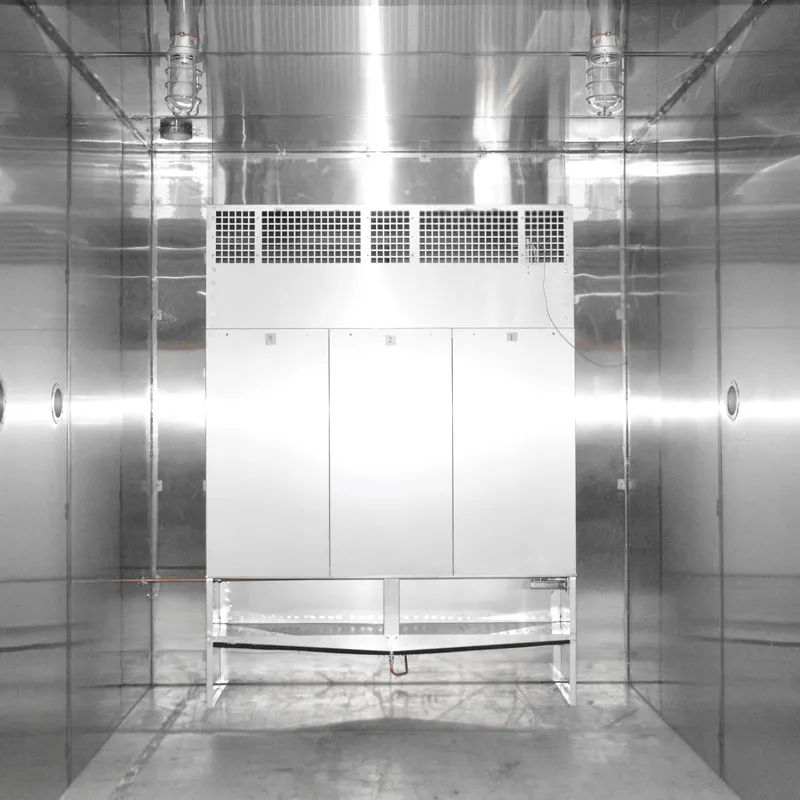
Walk-in environmental chambers save you in three places a bank of smaller cabinets cannot match: one load holds whole assemblies instead of many, one footprint replaces a row, and one large refrigeration circuit runs steadily where several small ones would short cycle. That is the short answer, and it is honest as far as it goes. The longer answer only holds when your parts and your test rhythm actually fit a room, so the real question is not which machine is better in general, but which one removes the constraint you actually have.
This guide follows the order a purchase decision really runs, not the order a brochure prints. We will work through five steps in sequence: the constraint you have to measure first, the throughput account, the floor space account, the energy and labour account, and finally the honest cases where a bank of smaller chambers wins. We build both, so we have no reason to pretend one always beats the other.
The short version, if you only read this far
- A walk-in earns its place when parts are large, heavy, wired, or awkward to lift.
- Throughput gains come from handling, not from test time: fewer loads, fewer door openings, fewer changeovers.
- Floor space per part tested usually falls, because aisles, doors and staging are shared instead of repeated.
- Small, numerous, independent parts still belong in small chambers, and we will say so plainly.
Step 1: Start With Your Real Constraint, Not the Chamber Spec
Before you compare machines, write down four numbers, because your bottleneck is always hiding in one of them. Teams that skip this step end up sizing a room around a part they will never actually test, or discovering a power limit after the order is placed.
- Largest part envelope and weight — length, width, height and mass of the biggest single item you will ever test, including its fixture.
- Test rhythm — how many units per day or week, how long each dwell lasts, and how long the load takes to reach stability.
- Free floor area — the space you can actually give up, counting clearance for opening the door and rolling a cart in.
- Connected power — the electrical capacity your building can supply to the test area, not the capacity you wish you had.
Those four numbers decide the category before any model number appears. If the biggest part is a battery module or a full cabinet assembly, no bench chamber will ever accept it, and the discussion is over before it starts. If the largest part is a phone-sized board and you only need one at a time, the numbers point the other way.
Once you know which of the four is tight, the next question answers itself: can one room absorb the whole workflow, or do you need several machines running in parallel? That is exactly what the throughput account settles.
Step 2: The Throughput Account — One Load Versus Many
Throughput is almost never decided by dwell time. It is decided by handling time, and handling time multiplies with every separate cabinet you open. That is the whole lever, and it is easy to miss because the datasheet only talks about temperature.
Here is the mechanism in plain terms. In a bank of small chambers, every part goes through the same loop: load it, wait for the chamber to recover, hold, open the door, unload, log it, then do the same thing again for the next batch. The test itself is identical in both cases. What changes is how many times a human touches the product, and how many times a machine has to re-stabilise after a door opens.
| Activity | A bank of small chambers | One walk-in chamber |
|---|---|---|
| Loading and unloading | Every cabinet opened and closed on its own schedule | One door, one ramp, one cart trip for the batch |
| Recovery after door opening | Each unit re-stabilises separately, every time | The room re-stabilises once for the whole batch |
| Changeover between part types | Repeated cabinet by cabinet | One changeover for the whole room |
| Operator attention | Split across many machines at once | Focused on a single load |
The pattern is consistent: fewer handling events, fewer changeovers, less idle waiting. In our tests, the gain shows up fastest in programs where parts are heavy or wired, because the manual effort per unit is what limits the day, not the controller. A single move with a cart beats eight separate lifts into eight cabinets, no matter how fast each cabinet is.
Fewer handling events is the whole mechanism. Once you see that throughput lives in handling rather than dwell, you are ready to look at where all those handling events physically happen.
Step 3: The Floor Space Account — One Room Versus a Row
Floor space is where walk-in environmental chambers look deceptively good, because the cabinet body is only part of the footprint you must provide. The working volume is what you compare, but the aisles and clearances are what you actually live in.
A row of small chambers needs an aisle in front of each unit, clearance for every door swing, and usually a separate staging area where parts wait their turn. A single room shares one aisle, one entry and one staging zone across the whole batch. Add up the aisles and the door clearances, and the apparent smallness of each cabinet quietly disappears.
Two design choices sharpen that advantage further. First, the room is fitted with double doors and an entry ramp, so a loaded cart or pallet truck rolls straight in and the operator never lifts the product — this matters most for the largest, heaviest item in the batch. Second, the room can be laid out in AB or ABC configurations, which lets the working zones follow your handling flow instead of forcing your flow to follow the machine. The interior is SUS#304 stainless steel backed by galvanized steel sheet, with a bottom secondary drainage path so wash-down and condensate stay away from the load.
Space per part tested is the number that actually matters, and it is the number most spreadsheets never calculate. As a reference point, our walk-in temperature and humidity test chamber is built around exactly that doorway logic. The walk-in environmental test chamber range lists the room types and volumes so you can compare them against the row you are replacing.
Once floor space pushes you toward one larger room, energy and labour take over the calculation — and they behave differently from the way a datasheet suggests.
Step 4: The Energy and Labour Account
Two rooms that reach the same temperature are not equally efficient, and the gap is not only about kilowatts. It is about how many times you open a door and how many times a compressor has to start. That is a usage question, and usage is something you control.
- Cooling load — every door opening lets warm, moist air in, and the refrigeration circuit has to remove it. One large door opened once per batch creates far less load than many doors opened repeatedly.
- Refrigeration design — a standardized modular refrigeration unit can be scaled in stages as your test volume grows, so you are not buying peak capacity for a quiet month.
- Energy use — the electronic expansion valve control on this class of machine is quoted at up to 45% energy saving against fixed throttle designs, which matters most on a chamber that runs continuously.
- Labour — rolling parts in on a cart or pallet truck is a one-person job, where lifting the same parts into a bench cabinet is not. Custom sample carts and pallet trucks can be built to your part envelope.
Energy and labour both scale with the number of handling events and door openings, which is precisely what a room reduces. But there is a point past which that advantage reverses, and it is worth naming it honestly rather than pretending it does not exist.
| Feature | WBE-BRS walk-in chamber |
|---|---|
| Room types | AB and ABC configurations |
| Interior build | SUS#304 stainless steel with galvanized steel sheet |
| Drainage | Bottom secondary drainage |
| Access | Double doors with an entry ramp for carts and pallet trucks |
| Refrigeration | Standardized modular units, expandable as volume grows |
| Handling options | Custom sample carts and pallet trucks |
| Energy | Up to 45% saving with electronic expansion valve control |
Step 5: When a Bank of Smaller Chambers Beats Walk-In Environmental Chambers
The honest answer is that a bank of smaller chambers wins whenever your test items are small, numerous and independent — and that case is more common than the marketing usually admits. A room holds one condition. If your work needs many conditions at once, that single fact decides it.
| Your situation | Why smaller chambers win |
|---|---|
| Small, high mix parts in large numbers | Many units run at once, each independent, with no waiting for a single batch |
| Different conditions needed at the same time | A room holds one condition; separate cabinets hold several setpoints in parallel |
| Low and unpredictable volume | A small cabinet stays useful when volume drops; a room only makes sense on steady load |
| Tight power budget | Several small cabinets can be staggered in a way one large circuit cannot |
| One suspect part to isolate | Keeping a single part alone and monitored is simple in a dedicated cabinet |
None of that is a weakness of a walk-in. It is simply a different problem. A connector maker we worked with ran small batches of many variants and stayed with bench chambers on purpose, because the mix changed every week and a single room would have sat idle half the time. A customer testing complete battery modules went the other way, because there was no way to lift the module into a bench cabinet at all. Both decisions were correct, and both came from Step 1 rather than from a preference. Our new energy application page shows how the room-scale version is usually arranged for large packs.
There is no universal winner here — there is only the machine that matches the four numbers you wrote down in Step 1. If you want to see how this plays out across industries before you decide, the walk-in chamber applications guide steps through the common cases.
Frequently Asked Questions
How large does a part have to be before a walk-in chamber makes sense?
There is no fixed size, but the practical trigger is handling. Once a part needs two people, a hoist, or a cart to move, a room with an entry ramp starts saving you time before any test begins. If a part fits easily in your hands, a bench chamber is almost always the better first purchase.
Can one walk-in chamber run several different tests at the same time?
No. A walk-in is a single controlled volume, so it holds one temperature and humidity condition at a time. If your plan needs several different conditions running in parallel, you either schedule them in sequence inside the room or keep smaller chambers alongside it for the parallel work.
What keeps a walk-in chamber stable when we open the door mid test?
Double doors, an entry ramp and cart-based loading all shorten the time the door stays open, and a modular refrigeration system with enough capacity brings the setpoint back quickly once the door closes. The habit that matters most is batching: load everything the run needs in one move rather than trickling parts in through the session.
How long does a walk-in chamber take to be delivered?
Standard models leave our plant in 15 to 20 days. A walk-in is often built around the room you already have, so the timeline depends on how settled your drawing is. The fastest projects are the ones where the part envelope and the door position are fixed before the order is placed.
Walk-in environmental chambers are not the right answer for every lab, and any supplier who says they are has stopped listening. They are the right answer when your parts are large, your handling is the real bottleneck, your floor space is scarce, and your test mix can share one condition. Measure the constraint first, run the three accounts in order, and the machine — room or row — will choose itself.
Size the room around your worst-case part
Send us the part envelope, the test rhythm and the space you can free, and we will tell you whether a walk-in or a bank of cabinets fits better.
See walk-in chamber specifications Tell us your part size