


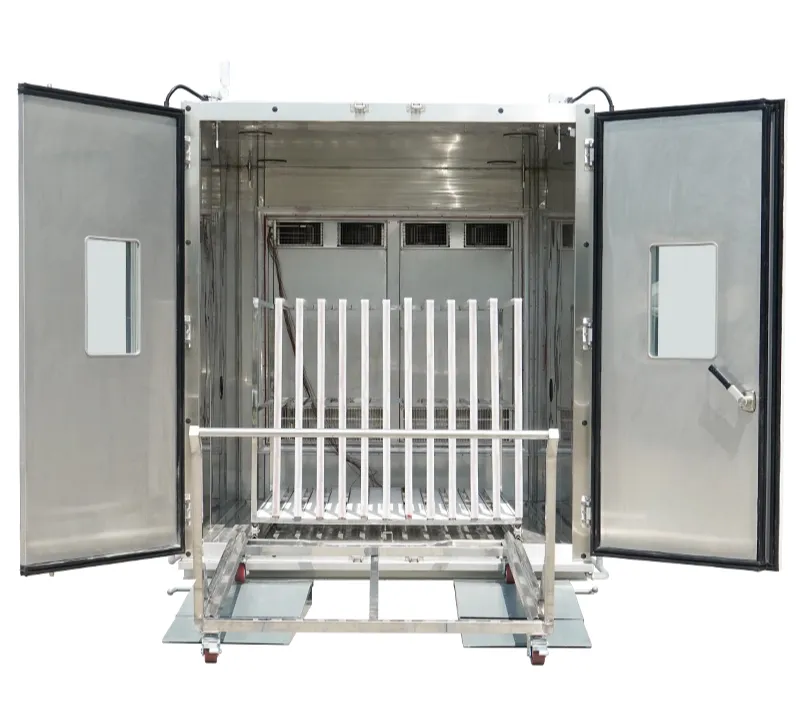
Most environmental test chambers look excellent on a specification sheet and behave differently the moment you switch the product on. The gap is live load: the heat a powered device generates inside the chamber, plus the thermal mass of fixtures, cables, and racks. This load is the single largest reason a chamber that held ±1.5 K in an empty room drifts once a real assembly is running inside it.
Environmental test chambers are rated under a defined load condition, and that condition is usually an empty or lightly loaded workspace. When you add 300 W, 500 W, or several kilowatts of live dissipation, you are asking the refrigeration and heating systems to compensate for a heat source the rating never included. Understanding that gap — and closing it with adaptive load control — is what separates a chamber that produces usable data from one that produces arguments.
What Counts as Live Load in an Environmental Test Chamber?
Live load is any heat or moisture source inside the workspace that the chamber did not create. It falls into four categories, and most real tests combine at least three of them.
| Load Source | Typical Magnitude | What It Disturbs |
|---|---|---|
| Powered DUT dissipation | 50 W to several kW | Pull-down time, compressor duty, steady-state setpoint |
| Fixture and rack thermal mass | 10 to 80 kg of aluminium or steel | Ramp rate, soak time, recovery after a door event |
| Cable and feed-through leakage | Continuous small heat path | Zone uniformity near the port wall |
| Operator traffic and door openings | Burst load, seconds to minutes | Humidity recovery, condensation risk |
The first row is the one that catches most test engineers. A 225 L chamber rated for −40 °C can reach that setpoint empty without strain. Put a 500 W DC-DC converter inside and the same chamber must now remove that 500 W continuously, on top of the heat leaking through the walls, while still holding temperature within the tolerance band.
Why Do Live Loads Push Environmental Test Chambers Off Setpoint?
Live loads disturb environmental test chambers through three separate physical paths, and fixing one does not fix the others. Pull-down time stretches, spatial uniformity degrades, and humidity control loses authority. A chamber can pass a temperature check and still fail on uniformity two hours into the run.
Path one: reduced cooling margin. Refrigeration capacity is finite. Every watt the product dissipates is a watt the evaporator no longer has available for lowering air temperature. At low setpoints the compressor runs closer to continuous duty, and the reserve that handled a 1 °C/min pull-down disappears. If your test calls for a controlled ramp to −40 °C with the unit powered, the achievable rate can drop well below the empty-chamber figure.
Path two: broken uniformity. A powered test board does not heat the chamber evenly. Heat rises from the components, forms a plume, and creates a local hot zone that the return-air sensor may never see. The result is a chamber whose display reads 85 °C while a thermocouple taped to the hottest component reads 93 °C. Uniformity figures such as ≤1.5 K are measured under defined conditions, and a concentrated heat source is not one of them.
Path three: humidity excursion. In damp-heat tests the load changes the moisture balance as well. A warm device drives evaporation from surfaces and from any condensate film, pushing local relative humidity above the setpoint. At 85 °C and 85 % RH, a few percent of local overshoot is enough to change the failure mode you are trying to reproduce.
Practical rule of thumb. Before specifying a chamber, add up the continuous dissipation of every device that will run powered inside it, then add the mass of the fixture. If the total exceeds roughly 20 % of the chamber's rated cooling capacity at your coldest setpoint, treat the quoted ramp rates as optimistic and ask for a loaded performance curve.
How Does Adaptive Load Control Keep Setpoints Honest?
Adaptive load control replaces a fixed control assumption with a continuous estimate of the actual thermal load, then adjusts heating and cooling output to match it. Instead of tuning one PID loop for an empty chamber and hoping it holds under load, the controller watches how the chamber responds and re-balances the refrigerant and heater output as the load changes.
On WBE constant-temperature and humidity chambers, this is implemented alongside servo-controlled airflow and an electronic expansion valve. The practical effect is that the same unit can hold a steady setpoint across a wide range of internal loads without the operator retuning anything between test runs. That matters in a lab where one chamber handles a bare PCB in the morning and a fully populated power module in the afternoon.
Three behaviours change when the control loop is load-aware:
- Overshoot at pull-in is reduced. A fixed-gain loop tuned for an empty chamber tends to overshoot when it suddenly meets a hot load, then oscillate back. A load-aware loop anticipates the residual heat and trims output earlier.
- Compressor cycling settles down. Short-cycling is hard on the refrigeration circuit and shows up as temperature ripple. Modulating the expansion valve in step with measured load keeps the compressor in a steadier duty band.
- Soak stability holds through the dwell. During a long high-temperature soak, the load is constant but the fixture mass is still absorbing heat. Load-aware control keeps trimming so the chamber does not creep upward over the final hours of the dwell.
What Should You Specify Before Buying?
Specify the loaded condition, not the empty one. Five items decide whether a chamber will hold its setpoint in your actual test, and all five are worth writing into the purchase specification.
| Specification Item | What to Ask |
|---|---|
| Loaded performance curve | Ramp rate at your actual dissipation, not the empty-chamber number |
| Cooling headroom | How much capacity remains at the coldest setpoint with the load applied |
| Airflow pattern | Top supply and bottom return keeps the plume from pooling at the ceiling |
| Anti-condensation design | Roof geometry that stops droplets landing on the DUT |
| Control mode | Whether the loop adapts to load or requires manual retuning |
Chamber volume matters here as much as control strategy. A 500 W load in an 80 L workspace is a different proposition from the same load in a 1000 L workspace. WBE builds the range from 80 L through 150 L, 225 L, 408 L, and 1000 L, so the practical move is to select the smallest volume that still fits your fixture, then confirm the cooling margin at that volume with the load applied.
What Does This Mean for Environmental Test Chambers in Production?
In production screening, the cost of load blindness shows up as false passes and unnecessary re-tests, not as a dramatic failure. A chamber that reads on-setpoint while the DUT runs hotter than intended has quietly changed the stress level of every unit that passed through it.
One power-electronics manufacturer we worked with ran 85 °C / 85 % RH screening on 300 W modules in a 408 L chamber. Units near the centre of the rack failed at a noticeably higher rate than units near the walls. The chamber display was stable the whole time. An independent thermocouple survey found a 6 K spread across the rack, driven by the modules' own heat and by the rack shadowing the return path. Re-siting the rack, adding a low-speed circulation fan, and enabling load-adaptive control brought the spread inside 2 K and made the failure distribution match the process expectation. The lesson was not that the chamber was defective; it was that the empty-chamber rating had been read as a loaded one.
For teams running environmental test chambers across multiple product families, the same logic argues for documenting a load map for every test setup: what dissipates, where it sits, what fixture mass it adds, and which sensor is treated as the reference. That document is more useful than a stack of empty-chamber certificates when a customer asks why two labs get different results on the same design.
Check your chamber against a real load, not a datasheet
Send us your dissipation figures, fixture mass, and target profile. We will tell you what the chamber can actually hold, and where the margin runs out.
Send Your Test RequirementsFAQ
Does a live load void the chamber's stated uniformity?
It does not void it, but it changes the condition under which the figure was measured. A uniformity of ≤1.5 K describes a defined, usually lightly loaded workspace. With a concentrated heat source you should re-verify uniformity with thermocouples at the DUT, not rely on the empty-chamber value.
Can I simply buy a bigger chamber to absorb the load?
A larger workspace dilutes a point heat source, which helps uniformity, but it also increases wall heat loss and can reduce achievable ramp rate for the same refrigeration package. Volume and cooling capacity have to be sized together against the load, not traded against each other.
How do I know whether my chamber already has load-adaptive control?
Run the same profile empty and loaded, and compare overshoot, settling time, and compressor behaviour. A fixed-gain controller will show a distinct overshoot and a slower settle when the load appears. A load-aware loop will hold the same band with little change in behaviour.
Choose the Chamber Around the Load You Actually Run
Environmental test chambers are honest machines when they are specified against real conditions and dishonest when they are specified against an empty room. Add up the dissipation, measure the fixture mass, ask for loaded performance curves, and confirm that the control loop adapts instead of assuming. Do that, and the setpoint on the display will mean what it says.
Why Teams Specify WBE for Loaded Test Work
WBE designs and builds environmental and mechanical test equipment in Dongguan, China, and supports installed units through a global service network. Four points matter when the chamber will run powered loads:
- Six product lines from one supplier. Temperature and humidity chambers, thermal shock chambers, rapid temperature change chambers, walk-in rooms, mechanical testing machines, and special-purpose test equipment — a mixed qualification programme stays under one supplier and one service contract.
- Load-aware control built into the platform. Servo airflow control, an electronic expansion valve, and adaptive load compensation belong to the chamber design rather than being added as a module, which is what holds setpoints steady when dissipation changes between runs.
- Figures you can re-verify in your own lab. Temperature uniformity ≤1.5 K, fluctuation ≤±0.3 K, humidity range 20–98 % RH, and A / B / D temperature variants covering −20 °C down to −70 °C — all reproducible with an independent thermocouple survey after installation.
- Support that continues after commissioning. Installation, calibration and compliance support, operator training, and spare parts keep a chamber inside its validated band after handover.
Related reading: how environmental test chambers work in industrial testing, and the WBE-SDJ constant temperature and humidity chamber specification.